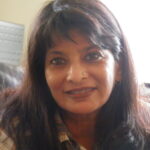
I’m Nazia, the founder/creator of Dementia Sphere. I’m a management consultant/researcher by profession and an avid baker and crocheter. I was born and brought up in London, England to Indian parents who moved from Assam, India in the mid 1950’s. We were a small family unit of four; my parents, my younger sister and me.
My parents raised me as an equal, never limited by traditional expectations. They rejected the idea that a son was more valuable than a daughter and involved me in important family decisions from an early age. My mother sought to protect me, while my father encouraged me to explore, take risks, and learn from life. He became my mentor and strongest supporter, especially of my love for travel. His belief that independence and exploration were forms of education gave me the confidence to live fully and on my own terms, knowing I always had his pride and encouragement behind me.
I spent most of my childhood in London before moving to the USA for my education and returned to UK in 1985 where I started my professional life. A chance opportunity in 2000 took me to the Middle East and in 2005 I moved to Dubai to work out there. It’s where I met my husband and it was the happiest time of my life. After 8 years in Dubai, my husband and I moved to Northern Sweden and then returned to London in 2019 to look after my mother who was diagnosed with Alzheimer’s Dementia. At around the same time I started volunteering with Alzheimer’s Society.
My mother passed away in April 2020 at the beginning of COVID and it took me a while to even think about writing. I was working on another venture when writer’s block crept in. I felt the universe was trying to tell me it was time; time to write our story; the journey of mum’s dementia. I realised whilst writing it that not only did our journey have moments of sadness, frustration, anger and joy, but there was so much more to both our lives than mum’s diagnosis.
I am now semi-retired and live in London with my husband, where my focus is to create awareness of dementia, both written and spoken. When I’m not advocating for the disease, I enjoy traveling, reading, spending time with friends and family, baking and crochet.
Reflecting on our journey, I realise that to fully acknowledge and appreciate our story it is necessary to provide some context of our wider family background.

My mother was born and brought up in Assam, India and lived there until she moved to London in 1956, a year after marrying my father. Initially, a housewife, she then worked in the Indian High Commission in London. She was always active until she gave up her job in 1971. After she gave up full time work, she went onto teach English part-time, to women in the Bangladeshi community in East London.
My father qualified as a barrister and planned for our family to return to India, but the birth of my sister and the discovery of her significant additional needs changed everything. With no clear diagnosis despite years of medical appointments, our family life came to revolve entirely around her routines and care and my mother was her primary carer.
Mum was very creative and loved any kind of handicrafts. Growing up I clearly remember her spending many of her afternoons or weekends sewing clothes or knitting cardigans and sweaters for either my sister or myself. When I was a baby, she apparently won competitions run by women’s magazines for her knitting several of which I still have tucked away in a box. My father was very supportive of her, always encouraging her to fulfil her dreams and aspirations. She loved to cook, bake, sew, knit, was an avid tennis and snooker fan and adored tending to her garden when she had the time.
In my late teens I remember that she enrolled in a course in dress making at the London College of Fashion and did well until she was forced to give up her course because of pressures at home. From then on everything was about taking care of us. My sister being autistic, and less able than most children meant that my mother spent her whole life devoted to her care taking and had little time for anything else.
I realise now in hindsight, that I grew up in an environment where a family member had to give up her professional life to take on caring responsibilities. This went full circle for me when I had to take on a similar role and give up my professional career after my mother’s dementia diagnosis. However, unlike in many South Asian families, I managed her care remotely whilst abroad and when I returned to the UK, rather than being a full time hands on carer.